
I only made it to one and a half classes this week—Monday was a holiday, and I missed part of Tuesday and all of Thursday for a work trip. That meant I started my Friday make-up session (solo in the studio) feeling behind, both in time and in confidence. I made the mistake of peeking at my classmates’ paintings before I’d even set up, and that familiar voice came rushing in: you’re not doing enough. You’re not where you should be.
Friday was a long and messy solo session in the studio, where I worked for nearly four hours on a still life painting. Sounds like a good thing, but the feeling was anything but. About 45 minutes in, I wanted to give up. Everything looked bad. I felt frantic and impatient. But that long-game part of me that knows what I’m trying to do reminded me: frustration is a sign of learning. I’ve said that before, and this time, I had to really step into it. So I stayed. Three hours later, the painting still wasn’t amazing, but it had improved a lot. And so had I.
I’m realizing how little experience I’ve had taking a painting all the way through, start to finish. Not fixing things as I go, not jumping ship when it looks ugly. Just doing the boring and hard work of following the actual process: blocking in, layering, refining. It’s uncomfortable. Especially that early phase, when everything looks like a mess and you’re just supposed to let it. This week gave me what I need most right now: 1) grit, and 2) time doing the work. That’s how I’ll become a better artist and how I’ll build trust with myself.
Painting is a “convincing lie.” You’re indicating, not replicating.
For my one in-class day, I had a small breakthrough with Tuesday’s Bob Ross-style exercise. The point was to go fast, to work with all your materials and tools, and to let paint drip, layer, and gloss over it with linseed oil. Our instructor was giving us direction for what to try, when to change to the next thing, and wasn’t letting up on the pace. At one point, she said, “Once you have at least three paint drips, you can move on.” I had tried to make some, but when she came by, she asked where they were. Apparently, my drips were a little too dainty and contained. I was clinging to control, even in chaos. I let a few big, greenish-brown drips go. It was oddly freeing. The pace, the looseness, the permission to make a mess—it’s everything I say I want, and everything I still resist. But I ended up liking the final product, which you can see above.
At the end of class, I told my instructor that my goal now is to “be messier.” She laughed and said that was a great direction. I love having someone like her as a partner in this, who can give me some structure and challenge, along with the space to grow.
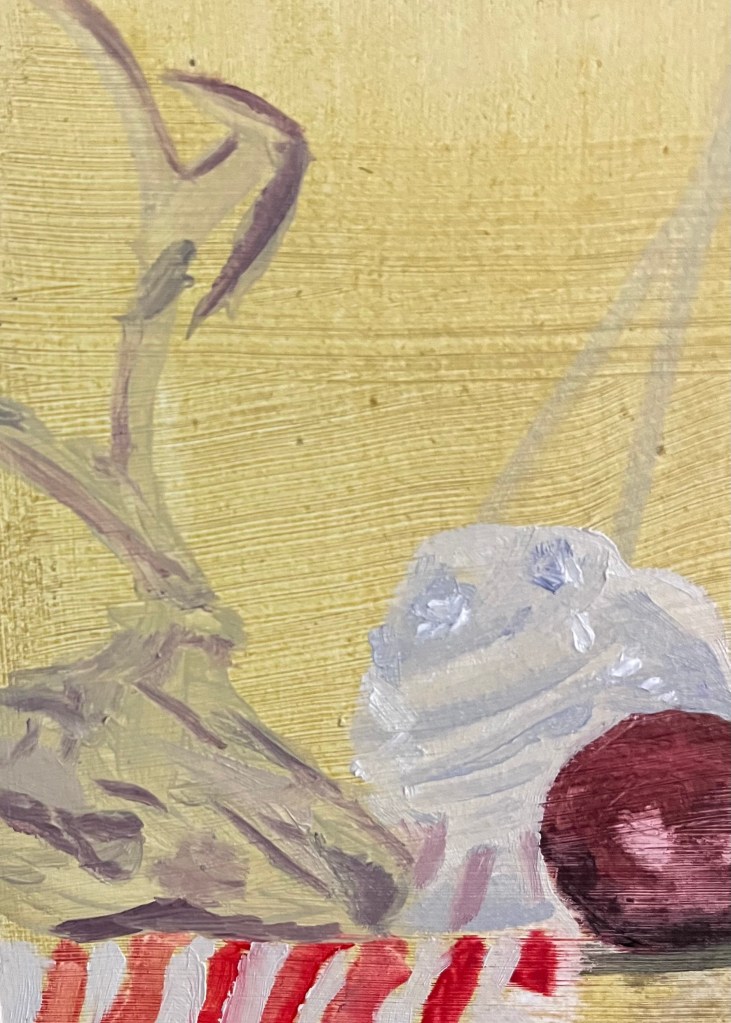
But back to Friday. My self-directed studio session gave me one big shift from my frustration to feeling like I was making progress. When I moved from the busy overall still-life scene to focusing on specific objects, I felt so clear and saw the next step, and the next, and the next, without even really having to try. Once I honed in on the deer skull, or an apple or piece of fruit, something clicked and I got an actual sense of clarity. I realized how overwhelming it can be to try to give everything equal attention and detail in a painting. I had chosen too wide a view, and there was just too much going on—fabric, shadows, bottles, reflective surfaces. I’m learning to focus in on what matters in the scene and lean into that—you only need to give detail to what you want people to focus on. The rest can just be suggestions. As our instructor said, painting is a “convincing lie.” You’re indicating, not replicating. And sometimes that means letting some parts fall away so the best parts shine.
Even though I missed what felt like a lot of class time, I kept thinking about it while I was away. There was this bittersweet moment at the airport as I was boarding the plane for this work trip—an awareness of how much I have to be grateful for. That I’m in a position where I can pay for an art class, and also miss it for the job that funds it. That I can pursue a new career while maintaining my current one. I thought about how many people don’t get that luxury, and how every decision I’ve made has brought me to this point. As we took off, I imagined all of my classmates’ easels arranged in a circle as they kept working on their still life pieces, my easel sitting there among them, empty. And how lucky I am that I get to come back to it.
So that’s the work right now. Not just learning to paint, but learning to stay with it—even when it’s messy, slow, or hard. Especially then.
 It's Henley